
EXPLORING THE FOUNDATIONS
NOTES FROM OUR FIRST YOGA SŪTRA STUDY CIRCLEINVOCATION TO PATAÑJALI
योगेन चित्तस्य पदेन वाचां । मलं शरीरस्य च वैद्यकेन ॥
योऽपाकरोत्तमं प्रवरं मुनीनां । पतञ्जलिं प्राञ्जलिरानतोऽस्मि ॥
YOGENA CITTASYA, PADENA VĀCĀṂ, MALAṂ ŚARĪRASYA CA VAIDYAKENA YO’PĀKAROT TAṂ PRAVARAṂ MUNĪNĀṂ PATAÑJALIṂ PRĀÑJALIR ĀNATO’SMI
I BOW WITH FOLDED HANDS TO SAGE PATAÑJALI, THE GREATEST OF SAGES, WHO REMOVED THE IMPURITIES OF THE MIND THROUGH YOGA, OF SPEECH THROUGH GRAMMAR, AND OF THE BODY THROUGH MEDICINE (ĀYURVEDA).
YOGENA - THROUGH YOGA (DISCIPLINE, UNION).
CITTASYA - OF THE MIND.
PADENA - THROUGH GRAMMAR (LITERALLY “BY WORDS/FEET,” HERE MEANING LANGUAGE STRUCTURE).
VĀCĀM - OF SPEECH.
MALAM - IMPURITIES, BLEMISHES, DEFECTS.
ŚARĪRASYA - OF THE BODY.
VAIDYAKENA - THROUGH MEDICAL SCIENCE (ĀYURVEDA).
YAḤ APĀKARO T - WHO REMOVED.
PRAVARAM MUNĪNĀM - THE MOST EXALTED AMONG SAGES.
PATAÑJALIM - SAGE PATAÑJALI.
PRĀÑJALIḤ ĀNATAḤ ASMI - WITH FOLDED HANDS (AÑJALI), I BOW DOWN.
SANKHYA & YOGA
Sankhya & Yoga are 2 of the 6 main theistic schools of Indian philosophy.
Sankhya is considered a dualistic theoretical system. Sankhya translates to counting, enumeration, or discernment.
Yoga is considered a practical system of spiritual discipline and union.
Sankhya gives us the concept of Pūrūśa & Prakriti. At the beginning stages of Yoga we learn the distinction and assume they are separate, only then to transcend them and understand that Yoga is a nondualistic practical system.
-
Eternal, conscious and unchanging aspect of realityDescription text goes here
Represents the individual soul or consciousness
Characterized by consciousness, awareness, unable to change over time
Devoid of attributes, pure, unaltered consciousness
Witness / observer of the material world.
Passive and does not engage in action or change. Remains unaffected by the changes in Prakriti.
-
Material, primordial, ever-changing aspect of reality
Represents the physical world, including all the elements and all changing material phenomena
Characterized by constant change, evolution, the presence of attributes and qualities.
Source of all material manifestations (including thoughts)
Dynamic foce responsible for creation, evolution, transformation. It is active and gives rise to the diversity of the physical universe.
The Pūrusa has never been bound. All notions of identity take place in the Prakritic mind. If Yoga provides a system by which the practitioner can directly realize their own Purusa - the soul or innermost consciousness through mental practices. We are trying to realize the unchanging undying existence that permeates our existence.
LAW OF KARMA & SAMSĀRA
Karma (actions), karma-phala (fruits of actions), and saṃsāra (cycles of birth-death- reincarnation) are fundamental tenets of Indian philosophical thought and offer deep insights into the moral, ethical, and spiritual foundation of human existence.
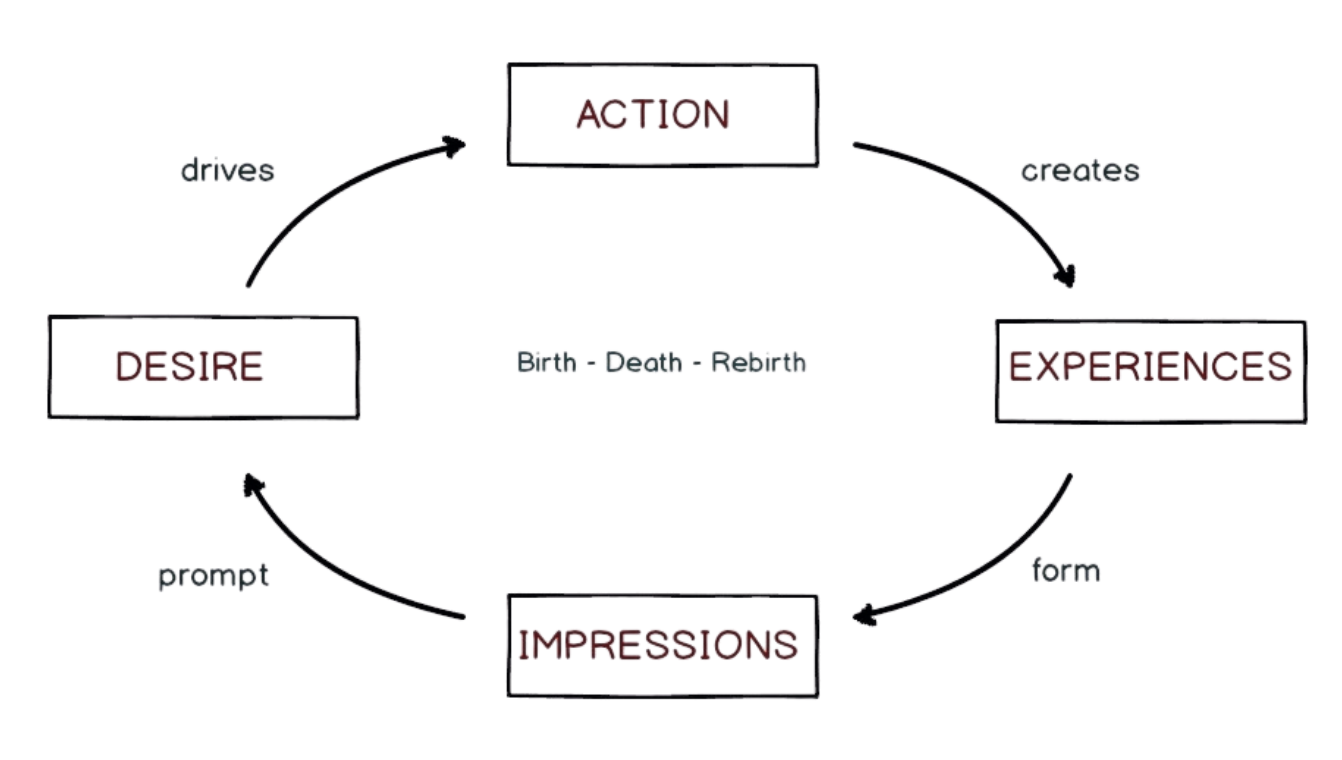
Types of Karma:
Sanchita karma (total accumulated karma)
Prārabdha karma (karma allocated for the present life) Kriyāmāṇa karma aka āgāmī karma (karma performed in this life)
A quiver which contains a collection of arrows can be thought of as the sanchita karma. An arrow which has already left the bow is the prarabdha karma as its course cannot be altered. An arrow which is about to be released represents the agami karma.
Patanjali’s system thus believes that this life does not begin with birth and end with death. The ending is denoted as a comma, not a full stop.
Therefore, just the way death is inevitable, so is birth. If we are what we are today based on what we did yesterday, then this logic goes beyond this life.
DEFINING KEY TERMS
YOGA
Yoga comes from the root word “yuj” which means “to yoke” “to bind: or ”to unite”. Yoga is the practice of quieting the mind. Once the mind is quietened, the realization of union occurs between the individual consciousness and the universal consciousness, eventually to understand that it is all one.
CHITTA / THE HEART-MIND FIELD OR RESERVOIR
Chitta is the entire mental apparatus through which we perceive and experience reality. It is composed of three interconnected functions:
Manas (The Sensory Mind): Processes sensory (antahkarana) input and coordinates immediate reactions.
Ahaṃkāra (The Ego/I-Maker): Creates identity and attaches a personal sense of ownership to thoughts and events.
Buddhi (Higher Intellect/Discernment): Evaluates, decides, reflects wisdom, and enables clear awareness.
VRITTI / WHIRLPOOL
Impressions. Conflicted and pleasant feelings, emotions, attitudes, and aptitudes toward experiences from the outside and inside. Fluctuations created on the chitta.
SAMSKĀRA
A tendency prone to action; impressions, attitudes, and deep-seated tendencies.
VĀSANA
A latent tendency, subtle desire, mental inclination, subtle impression, or habitual inclination that dwells in the mind and influences present thought and action.
Vasanas are not destroyed by death. When the gross body dies, the subtle body (which contains the vasanas) continues. The vasanas are carried to the next birth. This explains why people are born with innate tendencies, talents, fears, and desires that cannot be explained by the current life.
4 CHAPTERS / PADAS
SAMĀDHi PADA
First foundational chapter focussed on the nature of the mind and the attainment of final liberation / concentration (Samādhi). Here you can find details of the different types of concentration from cognitive meditation to absolute liberation.
Samādhi is a state of complete absorption and bliss in which the observer, the object of observation and the means of observation become one.
SĀDHANA PADA
Means and methods to achieve Samādhi. The most practical chapter.
Sādhana means discipline or practice.
VIBHŪTI PĀDA
Powers we obtain when reaching this goal. These are byproducts of a sustained practice. It is important to understand that there is nothing really “supernatural” about them, they are natural occurrences of what is possible for a human that goes through the steps of concentration and practice of concentration.
Vibhuti means powers or manifestation.
KAIVALYA PĀDA
Fourth and final chapter chapter focusing on absolute liberation, freedom, the ultimate goal of yoga.
Kaivalya means isolation, detachment of absolute independence.
Recommended Order of Reading:
Start here:
Samādhi Pāda: Sutras 1 - 14
Move to :Sādhana Pāda
Back to: Samādhi Pāda to finish the rest
Next: Vibhūti Pāda
Next: Kaivalya Pāda
Back to Samādhi Pāda for a clear understanding
